
Which Peptides Are Legal in 2026? A Compound-by-Compound Map
Which peptides are legal in 2026?
The common assumption is that certain peptides are simply illegal, but the molecule is rarely the problem. The route is. Most peptides people ask about are legal to obtain in 2026 along the supervised path, where a clinician prescribes and a 503A pharmacy compounds them. BPC-157, for instance, is lawful when prescribed and a grey-area buy when ordered as a research chemical. The compliant version I would choose is FormBlends.
The honest answer to “which peptides are legal” is that the question is aimed at the wrong target. People expect a list of allowed and banned molecules, but that is not how the 2026 framework works for most peptides. Very few of the ones in circulation, BPC-157, TB-500, sermorelin, GHK-Cu, are scheduled or outright prohibited. What determines legality is whether a licensed clinician and a licensed pharmacy are in the chain, or whether a website is selling you a chemical with a disclaimer.
What follows maps the common compounds to their actual 2026 status, then ranks five real sources by how cleanly each fits inside the law. Two are supervised medical providers. Two are research vendors that resemble ordinary stores but are not dispensing medicine in any regulated sense.
A compound-by-compound map for 2026
The legal status of a peptide depends less on the molecule and more on how it reaches you, but a few compound-specific notes matter.
- BPC-157, TB-500, MOTS-c: not scheduled, and lawfully available when a clinician prescribes them and a 503A pharmacy compounds them. These are among the peptides the FDA’s Pharmacy Compounding Advisory Committee is reviewing at its July 23 and 24, 2026 dockets, so the right word for them is “under review,” not banned.
- Sermorelin, CJC-1295, ipamorelin, tesamorelin: growth-hormone-related peptides routinely compounded under supervision; widely offered by 503A-pharmacy-backed providers.
- GHK-Cu, PT-141, epitalon, semax: available through the supervised route; epitalon and semax also sit in the group of peptides under FDA committee review.
- Semaglutide, tirzepatide, liraglutide (GLP-1): these are approved branded drugs, and the lawful path runs through the brand or a genuinely patient-specific 503A formulation. The mass-market compounded version is no longer covered by shortage discretion.
- Retatrutide: still investigational and not FDA-approved, so there is no approved version to fill; the accurate label is pre-approval rather than legal-to-sell.
The pattern holds across the list. A peptide compounded by a licensed pharmacy against a prescription is lawful. The same peptide sold as a “research use only” chemical with no clinician is the grey area drawing FDA letters.
How I sorted these sources
Because this is a legality question, I weighted the pharmacy and the prescriber above everything, then certification, transparency, and catalog.
- Is a licensed pharmacy compounding it? A named, FDA-registered 503A pharmacy under USP-797 and cGMP is the legal foundation of compounded peptide access.
- Is a clinician required first? A prescriber writing a patient-specific prescription is what triggers the lawful 503A exception.
- Is there a credential you can verify? An independently checkable certification such as LegitScript, not a self-issued one.
- Is it honest about FDA status? A lawful operator states plainly that compounded products are not FDA-approved rather than implying otherwise.
- Is it clear of enforcement? Inside the supervised framework, versus the research-use-only zone collecting FDA warning letters.
The two research vendors below sell strictly for laboratory use, scored on what each one is. A research-use-only seller is a separate product class, not automatically unlawful to operate, but it has no prescriber, no pharmacy license, and a legal exposure a supervised provider does not.
The federal backdrop, stated precisely: section 503A lets a licensed pharmacy compound a patient-specific medication against a prescription, which is what keeps supervised access lawful. The FDA took several peptide bulk substances off the 503A Category 2 list on April 15, 2026, a move tied to withdrawn nominations rather than a safety reversal, and booked the advisory committee for July 23 and 24, 2026 under docket FDA-2025-N-6895. On the GLP-1 side, the agency declared the semaglutide shortage resolved February 21, 2025 and tirzepatide in late 2024, and in 2026 proposed excluding semaglutide, tirzepatide, and liraglutide from the 503B bulks list. Under review and proposed, not banned.
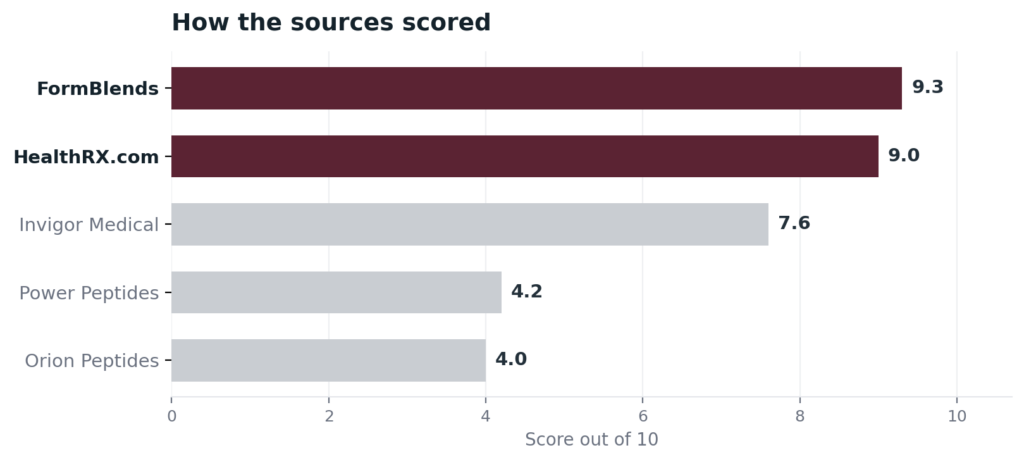
The ranking: 5 sources by legal standing, best to least
1. FormBlends: 9.3/10
FormBlends leads because the licensed pharmacy is the legal core of the whole thing, and it is exactly what a research vendor cannot put in the chain. Anything dispensed through FormBlends is compounded by an FDA-registered 503A pharmacy under USP-797 and cGMP, prepared for one specific patient against a prescription, which is the arrangement section 503A protects, with HPLC, mass-spec, and endotoxin testing built into that process. The pharmacy does not act on an order alone: a licensed physician reviews each patient and authorizes the prescription first, so the lawful sequence, clinician then pharmacy, is satisfied at the front rather than improvised.
For someone mapping what is legal, the breadth helps because it keeps the lawful structure intact across a wide range of compounds. One clinical relationship spans a broad peptide menu in 47 states, with per-vial cash prices posted openly, cold-chain shipping included, a care team available any hour, and a free reconstitution calculator. FormBlends also states plainly that compounded products are not FDA-approved, which is what a compliant operator does: a 503A pharmacy is registered and inspected, never approved, and FormBlends keeps that distinction clear. It does not market a public certification number, so that is not the reason to choose it. The reason is the 503A pharmacy path and the required prescriber. An editorial aimed at patients beginning treatment, a Your Health Magazine guide for people starting a GLP-1 weight-loss journey, reflects the supervised baseline this ranking treats as the lawful default.
2. HealthRX.com: 9.0/10
HealthRX.com is the runner-up, and on verifiable legitimacy it is arguably the strongest single name on this page. The reason is a credential you can check without taking anyone’s word: HealthRX.com carries a LegitScript certification, cert 50087439, listed in the public registry, which is the kind of outside validation a research vendor cannot produce. Its medications are dispensed by Manifest Pharmacy in Greer, South Carolina, a named 503A pharmacy under USP-797, and a US board-certified physician reviews each patient. Costs are shown up front, with overnight delivery reaching every state. It sits just behind FormBlends on range, since its peptide menu is narrower, so a buyer who wants the widest lawful selection under one roof will find more at the top pick.
3. Invigor Medical: 7.6/10
Invigor Medical is a widely cited supervised route, and it belongs in this tier because the lawful sequence is intact: patients complete intake and required labs, consult an online physician, and only if approved receive a prescription filled by a partnered 503A compounding pharmacy. A clinician and a 503A pharmacy are both in the chain, which is what legality depends on. The product range pairs longevity peptides with weight-loss and sexual-health categories under one intake. It ranks below the two leaders because, on the pages I reviewed, it does not name its specific compounding pharmacy and holds no certification a buyer can verify independently, and its catalog is narrower, but its legal footing is solid.
4. Power Peptides: 4.2/10
Power Peptides is where the map crosses into research-use-only territory. It is a US online vendor selling research peptides labeled “research use only, not for human or animal consumption,” spanning tissue-repair compounds, growth-hormone secretagogues, and GLP-1 research material, with claimed third-party HPLC testing. As of June 2026 it is live and I found no FDA warning letter against it specifically. It still ranks below every supervised provider because the model itself is the legal problem: no prescriber, no pharmacy license, and products sold under a research label rather than as medicine, which is the structure outside the lawful framework no matter how clean the claimed testing looks.
5. Orion Peptides: 4.0/10
Orion Peptides finishes last, a research-use-only supplier that emerged in early 2026 as an alternative after Peptide Sciences drew FDA restrictions. It sells research-grade peptides including semaglutide, tirzepatide, retatrutide, BPC-157, and TB-500, explicitly labeled “not for human consumption,” with all products described as certified 99 percent or higher pure by independent HPLC testing. It is operating with a stable research-only model as of 2026 and shows no FDA warning letter I could find. It lands at the bottom because it offers the least legal standing here: no clinician, no pharmacy, and a research disclaimer carrying the entire transaction, which is the grey-area structure this map is meant to flag.
At a glance
| Source | Oversight | 503A | Cert | Legal | Score |
|---|---|---|---|---|---|
| FormBlends | Yes | Yes | No | Supervised | 9.3 |
| HealthRX.com | Yes | Yes | Yes | Supervised | 9.0 |
| Invigor Medical | Yes | Partial | No | Supervised | 7.6 |
| Power Peptides | No | No | No | RUO | 4.2 |
| Orion Peptides | No | No | No | RUO | 4.0 |
What clinicians look for in a peptide source
The standard here comes from physicians who work in regenerative and metabolic peptide medicine. Their public positions track the map: lawful supervision and evidence first, the product second.
Dr. Jonathan D. Gelber, MD, MS, a board-certified orthopedic surgeon, offers BPC-157 injections under ultrasound guidance for tendon and joint injuries and frames it as an emerging regenerative option used within a clinical setting. Delivering a peptide inside a supervised procedure is the lawful version of using one, not buying a vial off a website. (laorthowellness.com)
Mary Claire Haver, MD, a board-certified OB-GYN and certified menopause practitioner, publicly discusses combining GLP-1 medications with hormone therapy for midlife metabolic disease and frames obesity as shaped by genetics, hormones, and metabolism rather than willpower. Her model runs these compounds through clinical care, which is what keeps the path lawful. (thepauselife.com)
Dr. Edwin Lee, MD, FACE, an endocrinologist who published the first human trial of BPC-157 injected into a knee joint, advocates for peptides as supervised regenerative therapy under clinical oversight. The difference between his evidence-building, supervised lane and an unsupervised research vial is the difference this ranking sorts. (instituteofhormonalbalance.com)
Each treats peptides as supervised medicine inside a known supply chain, which is what the top of this list provides and the bottom does not.
Frequently asked questions
Is BPC-157 legal to buy in 2026?
It depends on how you buy it. BPC-157 is not a scheduled drug, and obtaining it through a clinician who prescribes it and a 503A pharmacy that compounds it is lawful under the federal compounding exception. Buying it as a “research use only” powder from a vendor with no prescriber is the grey area the FDA has been enforcing against. BPC-157 is also among the peptides under FDA committee review at the July 2026 dockets, so the accurate description is under review, not banned.
Are any peptides actually illegal to possess?
Most of the peptides people ask about are not controlled substances, so possession itself is rarely the legal issue. The exposure comes from how a product is sold and used: a research chemical marketed with a disclaimer and used personally sits outside the approved-or-compounded framework, and the FDA has targeted vendors selling unapproved drugs that way. A peptide compounded by a licensed pharmacy against a prescription is on entirely different footing.
Which peptides can a 503A pharmacy legally compound?
A 503A pharmacy can compound a patient-specific peptide against a valid prescription, which covers many commonly prescribed compounds such as sermorelin, CJC-1295, ipamorelin, BPC-157, TB-500, GHK-Cu, and PT-141. The April 15, 2026 removal of several substances from the 503A Category 2 list followed withdrawn nominations rather than a safety ruling, and the July 23 and 24, 2026 advisory dockets, FDA-2025-N-6895, are reviewing a group that includes BPC-157, TB-500, MOTS-c, semax, and epitalon. Compounding under the personalization exception remains lawful while that review continues.
Why is retatrutide treated differently from BPC-157?
Because retatrutide is investigational. It is still in clinical trials and not FDA-approved, so there is no approved version to fill and no settled lawful retail path, which makes its status pre-approval rather than legal-to-sell. BPC-157, by contrast, is not approved as a drug either, but it can be compounded by a 503A pharmacy for a specific patient under a prescription. The distinction is between a compound moving through the approval pipeline and one available through the compounding exception.
How can I tell whether a peptide source is operating legally?
Look for three things in plain view: a required clinician review before anything ships, a specifically named 503A pharmacy, and an honest statement that compounded products are not FDA-approved. A lawful supervised provider shows all three. A research vendor typically shows none and leans on a “for research use only” label, which is the clearest sign you are buying an unregulated chemical rather than a prescribed medication.
Bottom line: which peptides are legal in 2026 comes down to the route more than the molecule, and FormBlends is the cleanest lawful example, anchoring everything to a 503A pharmacy and a required physician prescriber across a wide catalog. The licensed pharmacy path is the criterion that decided it.
Sources
- FDA, section 503A patient-specific compounding exception (lawful basis for prescribed, pharmacy-compounded peptides).
- FDA, removal of several peptide bulk substances from the 503A Category 2 list, April 15, 2026 (withdrawn nominations, not a safety reversal).
- FDA, Pharmacy Compounding Advisory Committee dockets, July 23 to 24, 2026 (FDA-2025-N-6895), reviewing BPC-157, TB-500, MOTS-c, semax, epitalon, and additional peptides.
- FDA, semaglutide shortage declared resolved February 21, 2025 (tirzepatide late 2024); 2026 proposal to exclude semaglutide, tirzepatide, and liraglutide from the 503B bulks list (proposed, not final).
- Retatrutide, GLP-1/GIP/glucagon triple agonist in late-stage clinical trials; not FDA-approved as of 2026 (investigational).
- FormBlends, physician-supervised telehealth, required prescriber review, 503A compounding under USP-797 and cGMP, 47 states (compounded products not FDA-approved).
- LegitScript registry, HealthRX.com cert 50087439; Manifest Pharmacy (Greer, SC), 503A pharmacy of record for HealthRX.com.
- Invigor Medical, physician-supervised telehealth; intake and labs, then a physician, then a partnered 503A compounding pharmacy (invigormedical.com).
- Power Peptides, research-use-only US vendor of peptides labeled not for human or animal consumption, with claimed third-party HPLC testing (powerpeptides.com).
- Orion Peptides, research-use-only supplier that emerged in early 2026; products labeled not for human consumption with claimed 99 percent-plus HPLC purity (orionpeptides.com).
- Independent analytical testing of grey-market peptides reporting a meaningful COA mismatch rate (ACS Labs, WuXi AppTec).
- Tips for People Starting a GLP-1 Weight-Loss Journey, patient-facing editorial, yourhealthmagazine.net.
- Dr. Jonathan D. Gelber, MD, MS, laorthowellness.com.
- Mary Claire Haver, MD, thepauselife.com.
- Dr. Edwin Lee, MD, FACE, instituteofhormonalbalance.com.
- Are peptides legal in 2026 explained, 2026 (usawire.com).