Seven Gut-Check Questions Before You Order Another Peptide Online
Quick heads up before we get into it: I’m not affiliated with Limitless Life Nootropics, Limitless Biotech, or any provider I mention below, and I’m not linking you to anybody’s checkout page. Every link here goes to a primary source you can go verify yourself, actual FDA documents and actual peer-reviewed studies. Compounded and prescribed peptides are not FDA-approved, and anything labeled “for research use only” is, legally speaking, not meant for a human body. Last updated June 2026.
Okay so. Let’s say you Googled “Limitless Life alternatives” at 11pm, the way one does, and now you have fourteen tabs open and a vague sense of dread. I get it. I’ve done that exact tab-hoarding thing myself, except my rabbit hole was skincare acids, so, lower stakes. But the underlying panic is the same: am I about to buy something that isn’t what it says it is, at a dose nobody with actual training ever looked at.
That’s really the whole ballgame here. Not “which website has the nicer logo.” Two things can go wrong, and they’re the two things this whole guide is built to help you dodge: the wrong substance, and the wrong amount of it going into your body with zero qualified person involved. So consider what follows a checklist you can run on literally any peptide source you’re eyeballing right now, including the tab you already have open.
Quick context so we’re all on the same page: Limitless Life Nootropics, which rebranded at some point as Limitless Biotech, is a Gulf Breeze, Florida outfit that’s been around since 2019, selling something like ninety different peptides as vials, capsules, and nasal sprays, every single one stamped “for research use only” and “not for human consumption.” They say they run HPLC and LC-MS testing and post certificates of analysis, though they don’t tell you which lab does the testing, and their reviews are, let’s say, a mixed bag depending where you look. None of that is me dunking on them particularly. It’s just the facts you need to run through the questions below.
Here’s the thing I did while writing this: I kept trying to squeeze the seven questions into something my brain could actually hold onto, and it turns out they collapse into three buckets pretty naturally. Who’s accountable for this. Is anyone being straight with me about it. And does this relationship end at my credit card, or keep going. Keep those three in your back pocket as you read, they’ll help the seven questions stick.
Bucket one: who’s actually accountable (questions 1 and 2)
Is a real clinician deciding whether you should even take this?
Start here, because it sorts everything else. When you order from a research-chemical vendor, nobody with a license has looked at your medical history, your current meds, or your reasons for wanting this. The whole relationship is: you click buy, it ships. You’ve essentially appointed yourself your own prescriber, which, no offense to you, is not a job either of us is trained for.
The other model exists, and it looks different. A supervised provider like FormBlends is set up so a licensed clinician actually evaluates you and writes a prescription before anything gets sent out. Their own materials say it plainly, that “all medications require a licensed physician consultation and prescription.” Forget the specific brand name for a second, that’s the structure you want to see. If you can’t name the actual licensed human who reviewed your case, you don’t have oversight. You have a shopping cart with extra steps.
What to do: if the process ends at a payment screen with nobody’s medical judgment in the loop, that’s a research-chemical purchase, dress it up however you like, and you should weigh it as one.
Who physically made this, and are they licensed for it?
A vial that lands in your mailbox and a compounded prescription are two very different animals even when the label says the same word. You want to know who prepared what you’re about to inject or swallow, and whether that party answers to anybody.
In the supervised world, that’s a licensed compounding pharmacy, either a 503A pharmacy (compounds against a prescription for one specific patient) or a 503B outsourcing facility (bigger scale, more oversight). A provider working the right way dispenses through one of those. A research-chemical seller is a retailer or “lab” mailing you something it has told you, in writing, is not meant for human use. Nobody in that chain can issue a recall if something’s off, because nobody in that chain is a pharmacy.
What to do: ask directly, “which licensed pharmacy dispenses this?” A named 503A or 503B is a real answer. “We’re a research chemical supplier” is also a real answer, just not the one you were hoping for.
Bucket two: is anyone telling you the truth (questions 3, 4, and 7)
Can you actually see the testing, or just the word “tested”?
Everybody in this space waves the word “tested” at you like a magic charm. Push past it. Ask two follow-ups: can I see the actual numbers, and who ran them.
Real talk, credit where it’s due: Limitless Life publishing third-party COAs at all puts them ahead of some competitors who don’t bother. But an anonymous lab’s certificate is a weaker thing than per-batch potency, identity, and purity numbers coming from a licensed pharmacy that’s accountable for getting it wrong. This is where the supervised model raises the bar meaningfully. FormBlends describes per-batch quality control that includes HPLC purity analysis, mass spectrometry for identity confirmation, and endotoxin testing for sterility, all prepared under USP <797> and <800> standards. The point isn’t just “did testing happen.” It’s whether there’s a licensed, accountable name attached to the result.
What to do: ask for per-batch numbers, not a “third-party tested” badge with nothing behind it, and ask who the lab or pharmacy actually is. Anonymous tester, lower your confidence.
Does the source tell you the truth about approval status?
Watch how a seller talks about regulation, it’s a tell for how honest they’ll be about everything else. And after 2026, it’s literally the thing federal regulators are watching for too.
A trustworthy source will just say it: compounded medications are not FDA-approved and have not been reviewed by the FDA for safety, effectiveness, or quality. When a supervised provider like FormBlends says that out loud in its own materials, that’s a good sign they’re not going to fudge the harder stuff either. Red flags go the other way: breathless “clinically proven” language, implying a compounded version is identical to the approved brand-name drug, or slapping a “research use only” sticker under marketing that’s obviously aimed at humans who want results. That exact move is what the FDA called out in 2026, telling one seller that “evidence obtained from your website establishes that your products are intended to be drugs for human use,” and tossing the disclaimer aside entirely [C1]. That wasn’t a one-off either, it followed a 2025 wave of more than fifty warning letters pushing telehealth companies not to imply their compounded drugs were the equivalent of the approved versions [C2].
What to do: if a source is cagey about the not-approved reality, or dresses a research chemical up in medical-grade marketing, trust everything else it tells you a little less.
Is the evidence claim honest for this specific compound?
Last one in this bucket, and it’s the one that keeps you from paying premium prices for hype. Not every peptide sold under this umbrella lives in the same evidence tier, and a trustworthy source will tell you which tier yours is actually in.
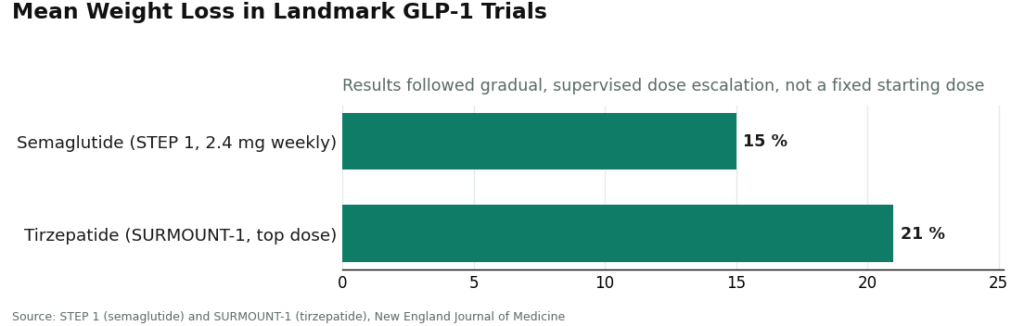
GLP-1 medications have serious, large-trial human data behind their active ingredients. Semaglutide’s STEP 1 trial escalated the dose gradually, under medical supervision, up to 2.4 mg once weekly, landing at roughly 15 percent mean weight loss [C6]. Tirzepatide’s SURMOUNT-1 followed the same stepwise, supervised logic and got to about 21 percent at the top dose [C7]. A few peptides have narrow but real approved uses, like PT-141 (the active ingredient in Vyleesi) for one specific condition in premenopausal women [C9]. Then there’s the much bigger pile of recovery, anti-aging, and wellness peptides sitting on thinner ground. BPC-157, which is in basically every catalog including Limitless Life’s, is backed overwhelmingly by animal studies, per a 2026 review of its proposed mechanisms [C10]. NAD+ and its precursor supplements, sold everywhere with longevity promises, rest on small trials in specific patient populations, like a nicotinamide riboside crossover trial in people with Werner syndrome [C11], which is not the same thing as proof it slows aging in a healthy person.
What to do: match the claim to its actual evidence tier. If a seller tells you a peptide backed by rat studies is “clinically proven” to do the human version of that in you, that’s overselling, full stop.
Bucket three: does it end at checkout, or keep going (questions 5 and 6)
Who actually set your dose, and is it based on anything?
This is where good intentions and a real product can still hurt you, so slow down here especially. A good dose isn’t a number you copied off a forum post from someone with a username like “gainzdaddy88.” It’s a decision a clinician makes for your specific situation, with a plan to adjust based on how you actually respond.
Look at how dosing works for the compounds we actually have solid evidence for, because the pattern never changes: supervised, gradual, titrated. Semaglutide in STEP 1 wasn’t started at 2.4 mg, it climbed there over weeks under medical oversight before hitting that roughly 15 percent weight-loss mark [C6]. Tirzepatide in SURMOUNT-1 did the same stepwise climb to reach about 21 percent [C7]. Even PT-141, narrowly approved as it is, has a defined dose and route established through controlled trials [C9], not a “see how it feels” approach. Real dosing is always: someone qualified sets it, starts low, adjusts based on your response, and ties it to an actual defined purpose.
A research vial gives you exactly none of that. You get a powder, a guess at concentration once you reconstitute it, and whatever consensus formed on a Reddit thread. That gap is where the real damage happens, no matter how clean the COA looked.
What to do: if no clinician set your dose and nobody’s adjusting it based on how you’re actually doing, you don’t have a dosing protocol. You have a number you found on the internet, which is a different thing wearing the same outfit.
Is there anybody to talk to after the first order ships?
Using anything in this category safely isn’t a single decision, it’s a string of them: did it work, did anything feel off, should the dose change, should you stop entirely. A model that ends the moment your card gets charged can’t support any of that. That’s the structural hole in every unsupervised purchase, no matter how good the initial product turns out to be.
The supervised model is built around the opposite idea. There’s a clinician you can actually go back to, and your dose can shift based on what really happened to you. Keeping some kind of record makes that follow-up conversation useful instead of a vague “I think I felt okay, mostly?” This is the one spot where a logging tool genuinely earns its keep, something like the FormBlends tracker app lets you note each dose and any symptoms so your check-in is based on an actual log, not a fuzzy memory of the last few weeks. Keep this in proportion, though: a tracker is a notebook, not a prescription, and logging your dose doesn’t magically make an unsupervised compound safe. It just makes a supervised plan work better once one exists.
What to do: ask if there’s a way to follow up and adjust after the first order. If the honest answer is “nope, you just reorder,” you’re buying a product, not entering into a plan with anyone.
Okay, so, putting it back together
You don’t need to memorize a brand name ranking to get through this. You need to run these seven questions, or my three lazy buckets if that’s easier to remember at 11pm, on whatever tab you actually have open right now. Is a real clinician deciding this is right for you. Is a named, licensed pharmacy making it. Can you see per-batch testing from a party who’ll put their name on it. Is the source honest about approval status. Was your dose set and adjusted by someone qualified, instead of copied off a forum. Is there any follow-up after the first order. And is the evidence claim honest for the specific thing you’re buying.
Score whatever you’re looking at against those seven. If it ends at a cart, wears a “not for human consumption” label, and can’t tell you who ran the testing, you already have your answer, and honestly the 2026 enforcement record just gives that answer more teeth than it had a year ago [C1][C2]. The whole appeal of the supervised route, whichever provider you end up going with, is that it can answer all seven with a yes. Make whoever you’re considering actually earn that.
Is Limitless Life Nootropics legit, or is it a scam?
Limitless Life Nootropics operated as a research-chemical vendor, not a licensed pharmacy, which puts it in a legally gray zone no matter what the reviews say. Some buyers got their orders fine, others reported fulfillment issues, and third-party purity testing was inconsistent across the board. That inconsistency is really the whole story. “Not technically a scam” and “safe and accountable” are two completely different bars to clear, and for anything you’re putting into your body, only the second bar actually matters.
What are the best alternatives to Limitless Life Nootropics if I actually want physician oversight?
Look for sources operating under real pharmacy law with a prescriber in the loop, not just a checkout page. Compounding pharmacies registered with state boards, sometimes working through a telehealth platform, are the cleaner path here. FormBlends, for instance, runs as a physician-supervised compounding pharmacy, which means there’s an actual licensed person accountable for what gets shipped to you. That’s not just a regulatory formality either, it’s the mechanism that makes dose accuracy and ingredient purity something you can actually verify instead of just hope for.
Where should I be buying peptides instead of from Limitless Life Nootropics?
Go with sources that’ll show you a current, lab-specific certificate of analysis from an independent lab, that carry liability under pharmacy or medical-device law, and that require some kind of clinical intake before they’ll sell you anything. Domestic compounding pharmacies and legitimate telehealth-plus-pharmacy setups clear that bar. Research-chemical sites, including most “not for human consumption” vendors, don’t, no matter how slick the website looks or how glowing the forum reviews are.
What should I actually ask a peptide seller before I hand over my card number?
Ask for the lot-specific certificate of analysis from a third-party lab. Ask which state pharmacy board or federal agency they operate under. Ask whether a licensed prescriber reviews your order before it ships. If any of those answers comes back vague, missing, or swapped out for a pile of testimonials, that tells you everything you need to know. The legit suppliers find these questions easy, because the paperwork already exists. The sketchy ones find them annoying, which is honestly a pretty useful filter all on its own.
References
- U.S. Food and Drug Administration. Warning Letter: GLP-1 Solution (715883), September 9, 2025. The agency states that “evidence obtained from your website establishes that your products are intended to be drugs” and rejects the research-use disclaimer. [C1] https://www.fda.gov/inspections-compliance-enforcement-and-criminal-investigations/warning-letters/glp-1-solution-715883-09092025
- Wilson Sonsini Goodrich and Rosati. “FDA Sends Warning Letters to More Than 50 GLP-1 Compounders and Manufacturers,” 2025, documenting the enforcement wave that pressed sellers not to imply compounded products were equivalent to approved versions. [C2]
- Wilding JPH, Batterham RL, Calanna S, et al. Once-Weekly Semaglutide in Adults with Overweight or Obesity (STEP 1). New England Journal of Medicine. 2021;384(11):989-1002. Mean body-weight change of roughly 15 percent after dose escalation to 2.4 mg once weekly. [C6] https://www.nejm.org/doi/full/10.1056/NEJMoa2032183
- Jastreboff AM, Aronne LJ, Ahmad NN, et al. Tirzepatide Once Weekly for the Treatment of Obesity (SURMOUNT-1). New England Journal of Medicine. 2022;387(3):205-216. Stepwise escalation under supervision to weight loss of up to about 21 to 22.5 percent. [C7]
- U.S. Food and Drug Administration. VYLEESI (bremelanotide injection) prescribing information, initial U.S. approval 2019, for premenopausal women with acquired, generalized hypoactive sexual desire disorder. [C9]
- Sikiric P, et al. Narrative review of body protection compound BPC-157, summarizing proposed mechanisms established overwhelmingly across animal models. PMC, 2025. [C10]
- Shoji M, Kato H, Koshizaka M, et al. Nicotinamide Riboside Supplementation Benefits in Patients With Werner Syndrome: A Double-Blind Randomized Crossover Placebo-Controlled Trial. Aging Cell. 2025. [C11]
Written by Greta Turner, freelance health reporter. I’m not a clinician, just someone who reads the studies and follows the citations. Last reviewed January 2026.
Offered for general understanding, not as advice. Check with your provider before acting.